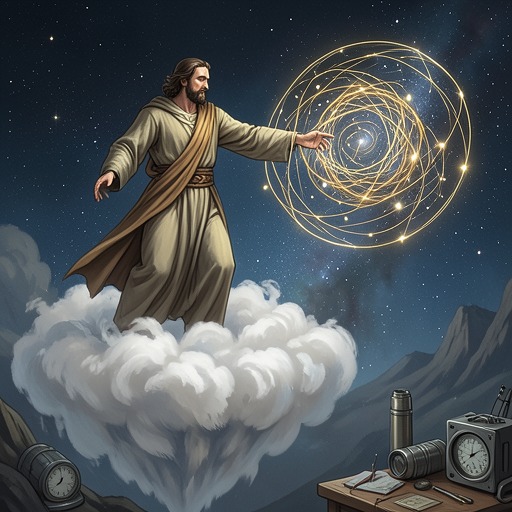
Law of Unchangeable Fate
Metamorphoses (Ovid Edition)The rule of immutable destiny is the governing principle that places every will—human, divine, and heroic—beneath an order no power can finally overturn. Its force appears not as a single decree but as a recurrent structure of prophecy, allotted time, inherited consequence, and foreseen outcome. The gods may delay, plead, disguise, protect, or punish, yet the narrative repeatedly insists that their authority does not include the power to rewrite what Fate has settled.
Definition and Scope
The rule is stated most directly during the dispute over the restoration of youth. When the gods quarrel over who may receive a second life of vigor, Jupiter rises and demands an end to their discord. His argument is not merely that a prior promise should be honored; it is that the promise itself was produced by the Fates. Iolaus had received a second youth through their determination, and the same destined power would grant renewed bloom to the descendants of Callirhoe. Arms and ambition cannot obtain this power, Jupiter declares, and even Jupiter is restrained by the Fates. Divine rank therefore governs many events, but it does not stand above the fundamental distribution of what must happen.
This principle also separates destiny from ordinary divine preference. The gods can possess competing interests, and those interests can intensify their quarrels, but conflict among the heavenly powers does not make the final outcome negotiable. The settled will of Fate is represented as a boundary that remains in place when every lesser authority has been exhausted. The rule thus supplies the poem with a hierarchy: individual desire acts within circumstance, divine command may shape the route, and Fate fixes the limit.
Prophecy, Time, and Birth
The rule becomes especially severe when prophecy is joined to biological time. In the account of the birth of Alcides, the approaching delivery is marked by the tenth sign moving forward across the sky. The mother’s womb has expanded under a burden so great that Jupiter is shown as the father of it. The celestial sign does not merely decorate the scene; it measures the appointed moment and turns pregnancy into a struggle against an astronomical deadline.
The threatened birth brings divine intervention into direct conflict with destined succession. Lucina is summoned during the mother’s cries, but she arrives prejudiced and prepared to make the woman’s fate a sacrifice to Juno’s hatred. Lucina sits upon the altar at the door while the labor continues, so that a private bodily crisis becomes an arena in which divine hostility attempts to obstruct what the heavens have already set in motion. The scene shows that Fate need not make events easy or merciful. Its immutability permits suffering, delay, and hostile interference even when the final outcome cannot be erased.
The Fates and the Limits of Divine Power
The rejuvenation dispute gives the clearest institutional image of destiny. The Fates are not simply a metaphor for uncertainty; they determine that Iolaus will receive a second youth and that Callirhoe’s line will be granted renewed bloom. The gods can debate the distribution of the gift, but they cannot claim the gift for themselves by force, status, or ambition. The controversy therefore reveals a limit built into the divine order: immortality does not mean unlimited control over age, transformation, or succession.
Jupiter’s intervention is significant because it does not abolish the rule in order to settle the quarrel. He settles the quarrel by recognizing the rule. His authority becomes legitimate precisely when it acknowledges a superior determination. Even the possibility of changing the past is presented as impossible; Jupiter explains that, if he could command the Fates, he would have prevented the rolling years from bending Aeacus beneath silver hair. The thought exposes the emotional cost of the law. Divine power can witness decline and regret it, but regret cannot become revision.
The same logic governs the boundary between oath and prophecy. Hebe has restored Iolaus’s strength, and a solemn oath has passed from her lips that he alone should taste the gift. Themis then speaks and checks the young goddess’s vow. The episode does not present the oath as irrelevant; it shows instead that a local promise can be overruled when it conflicts with a deeper order. Themis’s intervention makes destiny a corrective force within divine speech itself, preventing a verbal commitment from becoming stronger than the fate it has violated.
Prayer, Portent, and the Future of Rome
Destiny also controls the interpretation of signs. When a portent appears, the response is framed as a conditional prayer: if the sign is favorable, its outcome should be decreed for Rome; if unfavorable, it should fall upon the individual who asks. The prayer acknowledges uncertainty at the level of human knowledge, but it does not assume that prayer can manufacture the future. The worshipper can request that the omen be directed toward Rome, yet the sign still requires a verdict beyond personal desire.
At the end of the narrative, Jupiter directs a goddess to enter the dwelling of Fate to resolve her doubts. He tells her that heavenly powers possess the privilege of seeing the records engraved there. This image makes destiny archival and material: its decisions are written into records that can be consulted but not edited. Divine beings may gain access to the account, and recognition may replace uncertainty, but knowledge of the record is not mastery over it. The future of Rome is therefore secured not by a god’s arbitrary promise but by an order whose inscription precedes and limits divine action.
Narrative Consequences and Significance
The rule creates a recurring pattern of attempted intervention followed by recognition of limits. A goddess may sit at the threshold of childbirth, Hebe may restore vigor, Jupiter may command silence, a warrior may raise a lance, and a petitioner may build an altar and burn fragrant gums; none of these actions possesses the final authority to defeat destiny. Their importance lies in how they expose the distance between power and sovereignty. The gods act decisively, but the poem repeatedly distinguishes decisive action from absolute control.
This distinction also gives reversals their tragic force. A prophecy or destined outcome turns apparent freedom into foreknowledge after the fact: what first seems preventable becomes the fulfillment of an order that was always stronger than resistance. The suffering associated with the rule does not arise only from ignorance. It also arises from seeing what cannot be changed, as when the imagined inability to spare Aeacus his aged appearance converts divine power into helpless recollection.
The law finally links personal events to collective history. The birth of Alcides, the renewal of Iolaus, the fate of Callirhoe’s descendants, and the portent assigned to Rome all belong to different scales, yet each is governed by the same principle. Destiny reaches from the body and the family to the heavenly assembly and the political future. Its function is therefore both plot-mechanical and philosophical: it explains why transformations occur, why divine conflicts stop short of omnipotence, and why the world’s succession of changes remains ordered even when no individual can command its course.